How Pulse turned AI into a governed operating system.
Pulse uses defined digital roles, scheduled workflows, and bounded automation to support the ongoing development and maintenance of its workplace wellbeing platform - with human oversight built in.
40+
Defined digital roles
5 min
Case study film
4
Wellbeing pillars supported
Human
Oversight by design
Watch the case study
Responsible AI automation in practice.
This five-minute film shows the operational problem, the system Pulse put in place, and how governance turns AI from an occasional tool into dependable business infrastructure.
The operating model
Not a chatbot. A governed digital organisation.
The Creature coordinates more than 40 persistent, defined digital roles. Each has a bounded purpose, from product and engineering to research, content, quality assurance, security, governance, customer success, and commercial development.
The important distinction is structural. Pulse does not ask one general-purpose assistant to improvise its way through the business. Work is divided between specialists, checked against defined standards, routed for repair when it fails, and escalated when human judgement or authority is required.
A repeatable operating model
Defined roles and scheduled workflows turn recurring product, content, and quality work into a system instead of a collection of one-off prompts.
Bounded automation
Specialist automations work within clear responsibilities, evidence standards, and action boundaries rather than being given unrestricted control.
Human oversight where it matters
People retain control of sensitive wellbeing decisions, approvals, and accountability while automation handles repeatable operational work.
How work moves
From business need to governed outcome.
Semi-autonomous does not mean unsupervised. It means the system can carry work forward across multiple stages while preserving context, ownership, inspection, and clear stopping points.
Work is defined
A goal, issue, scheduled check, or improvement becomes a bounded piece of work with an owner, context, acceptance criteria, and explicit limits.
Specialists do the work
The system activates the relevant digital roles across research, product, engineering, content, media, security, or customer operations.
Output is inspected
Evidence, safety, accuracy, technical quality, and completeness are checked before work can progress. A generated answer is not treated as a finished result.
Failures become repair work
Missing sources, unsafe claims, broken behaviour, or incomplete work are routed back to the appropriate specialist with the failure context attached.
Humans retain authority
Public releases, customer communication, high-risk wellbeing content, and material business decisions remain behind explicit human approval boundaries.
Accountable autonomy
The safeguards are part of the system, not an afterthought.
AI becomes dependable business infrastructure only when the operating model assumes that outputs can be incomplete, wrong, or inappropriate. The Creature is designed to detect those conditions and stop or redirect work before it becomes an external action.
Evidence before confidence
Research favours authoritative government, regulator, public-health, and recognised expert sources. Unsupported claims are escalated rather than polished into certainty.
Quality gates with consequences
Inspection is part of the workflow. Work that fails a check does not silently advance; it creates a traceable repair task for the role best placed to resolve it.
Bounded external action
The system can prepare, coordinate, and recommend. Publishing, production releases, customer messages, and consequential actions require human authority.
Decisions prepared for people
Instead of burying leaders in raw agent output, the system presents the change, evidence, impact, risk, and decision required in a reviewable form.

The product being supported
A wellbeing portal people might actually use.
Traditional wellbeing programmes often scatter benefits across emails, provider portals, PDFs, and intranet links. A purpose- built portal gives people one place to start.
Visit Pulse NZFinancial
Money stress affects sleep, attention, and confidence. Support needs to be practical, private, and easy to find.
Nutritional
Food, energy, and planning tools sit beside wider wellbeing instead of becoming a disconnected content library.
Physical
Movement and fitness tools work best when they are one part of resilience, not the whole wellbeing programme.
Mental
Mental health resources become easier to approach when they are normalised inside a broader wellbeing portal.
The Pulse experience
Useful support, presented clearly.
Pulse brings practical tools and approachable wellbeing content into one consistent experience across desktop and mobile.
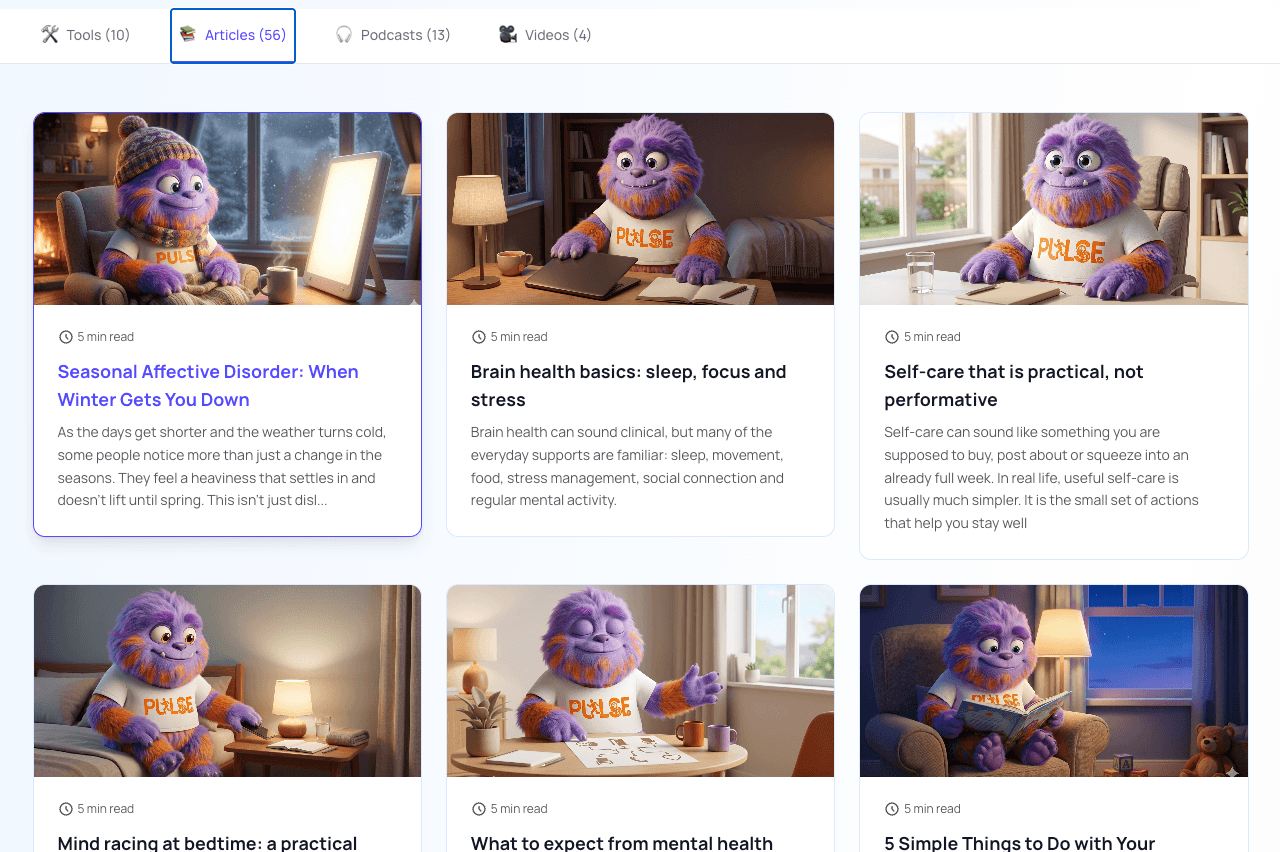
An approachable wellbeing library
Articles, podcasts, videos, and practical tools give employees several ways to engage with support.
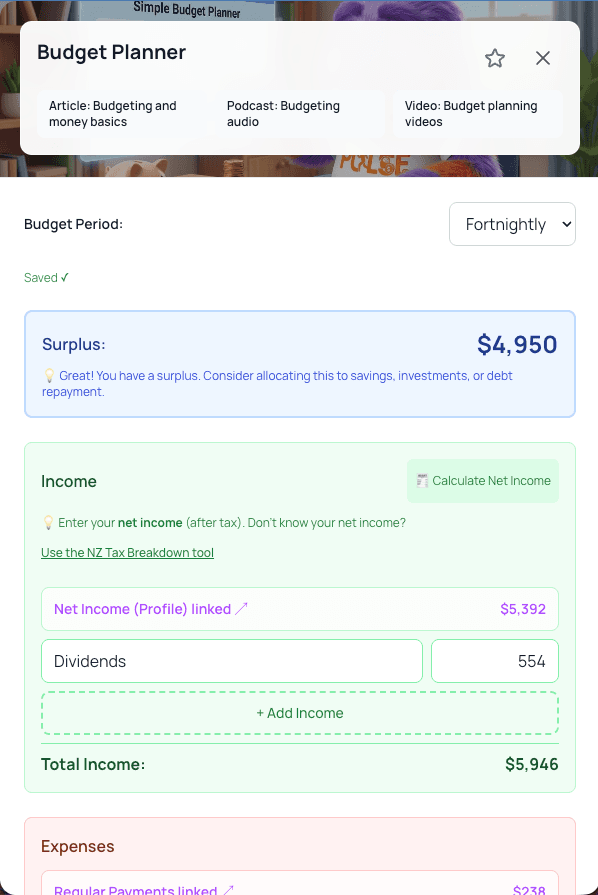
Practical tools, connected to the user
The budget planner turns linked information into a clear, useful next step on mobile.
Why this matters
Small teams can operate with multidisciplinary capacity.
Maintaining a trusted wellbeing platform requires sustained work across disciplines that a small organisation cannot usually staff continuously. The Creature provides that operational breadth without pretending AI removes responsibility.
The transferable lesson is not “add AI.” It is to design the organisation around bounded roles, durable context, inspection, recovery, and human authority. That is what turns automation from a clever demonstration into an operating capability.
Where the system helps
Repeatable research, preparation, inspection, coordination, and maintenance can continue across product, content, quality, and operations. People can then spend more time on judgement, relationships, priorities, and decisions that genuinely require human accountability.
See more proof examplesNext step
Where could governed AI increase your operating capacity?
Start with the recurring work, decision boundaries, evidence standards, and approvals. Then design automation around the way the business needs to operate - not around an isolated AI tool.